Financial institutions can use
existing APIs that Financial Performance Suite (FPS) has created for current expected credit
losses (CECL), customer profitability, forecasting, key rates, and rate sheets.
Administrators can save information that
is passed through APIs.
-
Select from the menu.
-
Select
Add.
-
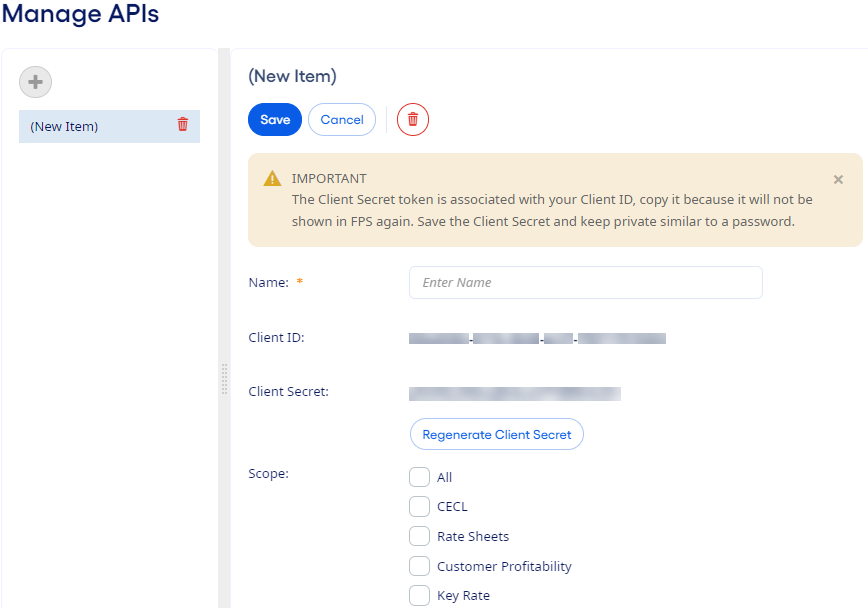
Enter a Name for the API for your own reference.
For example, you can name an API FPS Customer Profitability
API.
-
Select a Type.
- Select Client Secret to generate a client secret that is
associated with your client ID.
- Select Public/Private Key to generate a key or
enter a key manually.
-
Select a situation and follow the corresponding steps.
| Situation |
Steps |
| Using a Client Secret |
- Select Regenerate Client Secret, if needed.
A warning
message appears before regenerating the client secret.
- Copy and save the generated client secret in a secure location.
The client
secret is associated with your client ID and must be kept private like a
password.
|
| Using a Public/Private Key |
- Select Generate or enter a Public
Key manually.
You can select the Length of
the public/private secret before generating it. You can also regenerate the key
as many times as needed.
- Select Download, and then select either Public
Key or Private Key.
- Save the generated keys in a secure location.
|
-
Select the Scope to save and associate with this new item.
-
Select Save.
The data from the API connection is saved
on the client's side as a .json file.
To see IT-related documentation on how to access FPS APIs, open the Swagger
application at https://prod.profitstarsfps.com/swagger/index.html. The Swagger interface contains the parameters, responses, and schemas
for each of the APIs available through FPS.
To see your data in Swagger, you must access a separate URL that generates the
bearing token for authorization in Swagger. Contact FPS support at FPSSupport@jackhenry.com
for help with this process and with other questions that you have.